

Infrastructure Co‑Investments: Outperformance through careful selection
23-06-2026 Infrastructure
Access Capital Partners’ take on building diversified pan-European portfolios
Investors are navigating a combination of macro uncertainty, changing interest‑rate regimes and heightened expectations on sustainability and transparency.
In this environment, many investors are looking for exposures that are grounded in real economic activity, supported by long‑term demand and capable of generating predictable cash flows. Infrastructure can meet these objectives, and a disciplined co‑investment approach can be an effective way to access it.
This long‑standing presence has enabled the team to build durable relationships with a broad network of infrastructure GPs, supporting strong access to opportunities and disciplined investment execution.
Essential assets with long‑term demand drivers
At its core, infrastructure is made up of long‑life, physical assets that provide services societies rely on every day, from energy and utilities to digital infrastructure, mobility and social infrastructure. A defining feature is the essential nature of these services, which can help protect value through cycles because demand is often supported by structural needs rather than discretionary spending.
These trends can create multi‑year investment requirements and a steady pipeline of assets seeking capital, particularly as public budgets remain constrained and private capital becomes an important partner in funding and upgrading essential systems.
Predictable cash flows often underpinned by contracts or regulation
One of the most cited reasons for allocating to infrastructure is the potential for predictable and steady cash flows, frequently derived from contractual and/or regulated frameworks. Compared with many corporate business models, infrastructure revenues can be less dependent on short‑term demand fluctuations when contracts, concessions, or regulation provide visibility and enforceability.
Another widely referenced characteristic is lower correlation with GDP, which can limit volatility and enhance resilience when the economic cycle turns. While no asset class is immune to macro shocks, infrastructure’s underlying revenue mechanisms can be more defensive than cyclical sectors when the services provided remain essential.
Inflation and interest‑rate considerations: structural features can help, if well selected
In periods of inflation uncertainty, investors often look for real assets whose revenues can adapt over time. Infrastructure can offer protection against inflation through contractual and/or regulatory revenue indexation, or through pricing power where the asset benefits from a quasi‑monopolistic position, and the essential nature of the service it provides. Of course, inflation linkage is not automatic, it depends on the specific asset, contract and regulatory regime, which is why selection is critical.
Infrastructure can also mitigate interest‑rate exposure when financing is structured with long‑term debt and fixed rates, reducing short‑term refinancing risk and sensitivity to rate changes. This, again, is not universal, it is a function of how assets are financed and managed, but it is a meaningful part of the asset class toolkit for resilient portfolio construction.
Leverage discipline supporting long-term stability
Prudent use of leverage is a core pillar of risk management and long‑term value preservation. Excessive leverage is generally avoided, as it can amplify volatility, constrain distributions and increase refinancing risk, particularly in changing macroeconomic or interest‑rate environments. When applied conservatively and combined with stable, contracted or regulated cash flows, leverage can support disciplined portfolio construction while preserving downside protection for investors.
Proven stability of infrastructure returns across cycles
The essential nature of assets, predictable cash flows, downside protections and conservative use of leverage collectively underpin the structural resilience of infrastructure as an asset class, distinguishing it from other private and listed asset classes, across macroeconomic cycles.
Infrastructure delivers consistent performance across macroeconomic cycles
Return range per asset class in % - Smaller % = lower volatility
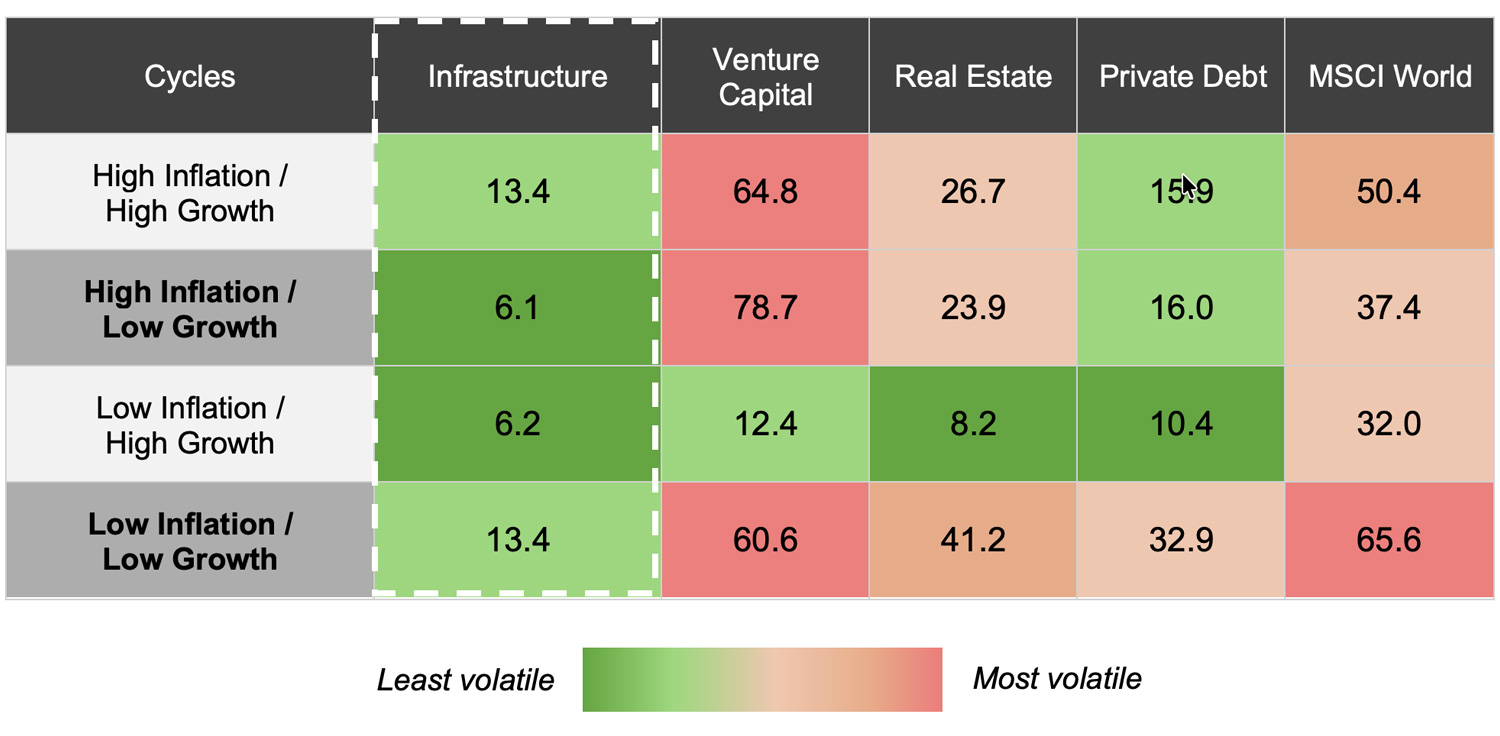
Source: Preqin benchmark and indices from Q1 2010 to Q4 2025. Macroeconomics cycles categorised by quarter following IMF World Economic Outlook; April 2025.
Why co‑investments: access, selectivity, a second layer of diligence, and broader diversification
Co‑investments are executed alongside established lead investors, such as fund managers or industrial partners, enabling exposure to individual assets while benefiting from the lead investor’s sector and value creation expertise.
“Access Capital Partners’ co-investment approach is about investing alongside specialised partners, while applying our own independent analysis, adding selectivity and strengthening downside protection.”
Agnès Nahum & Philippe Poggioli, Managing Partners at Access Capital Partners
At Access Capital partners, we believe a well‑structured co‑investment approach can offer three practical advantages:
Diversified, pre‑qualified deal flow. Investing with different lead partners can broaden opportunity sets and provide access to transactions that have already been pre-qualified by the lead investor. Access’ deal flow is particularly resilient across the market cycle. In highly active market environments, elevated M&A activity structurally generates a high number of co‑investment opportunities. Conversely, in more constrained fundraising environments, the deal flow remains robust, notably due to fund sizes falling short of managers’ initial targets or their desire to optimise the timing of their return to the market by partnering with co‑investors.
Double diligence for stronger downside analysis. We apply a second layer of due diligence on opportunities presented by experienced leads, strengthening the assessment of downside cases and helping reduce performance volatility.
Flexibility in transaction timing and allocation. We participate at different points in a process: early, later when execution risk is reduced, or post‑closing, depending on the competitive dynamic and the asset’s needs. This flexibility can contribute to low abort cost. Access also benefits from a flexible allocation approach, enabling it to invest selectively in sectors offering the most attractive opportunities at each stage of the cycle, while avoiding exposure to segments where market dynamics appear less favourable.
Our first-generation infrastructure co-investment fund consistently outperforms the market in net TVPI and net DPI and has generated a 2.1x average gross cost multiple across 10 exits.
Access Capital Partners Infrastructure Co-Investment Funds outperform the market
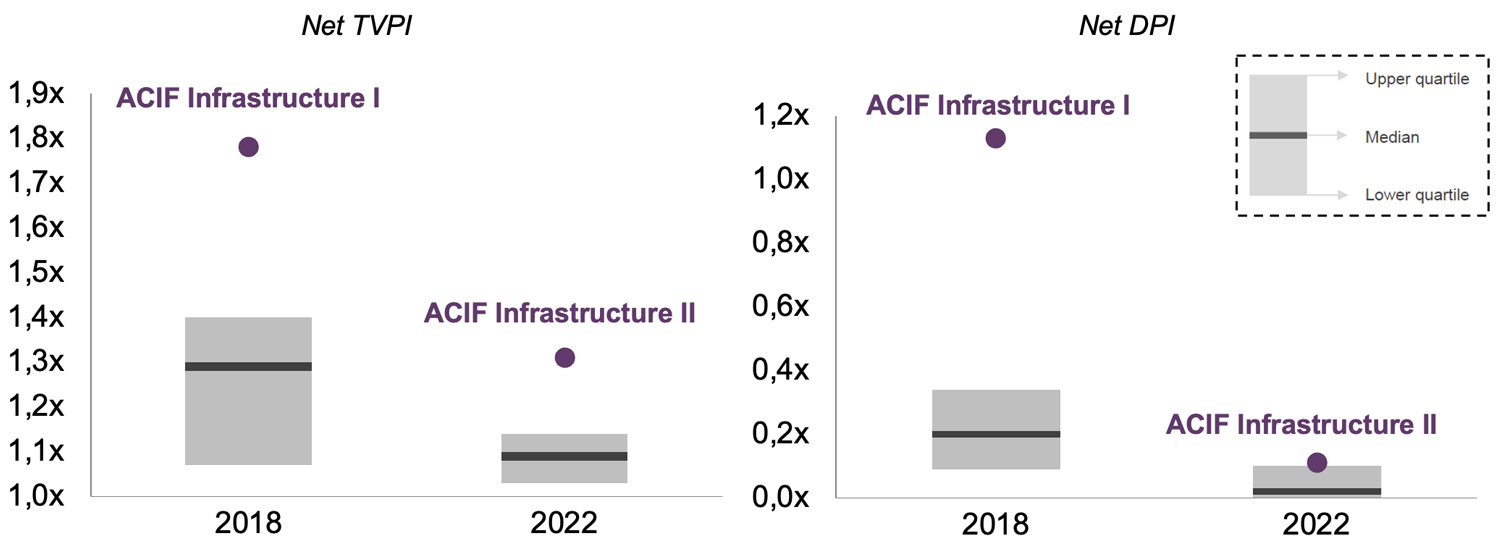
Source: Preqin Private Capital Benchmarks (Infrastructure – Europe); Access Capital Partners’ data estimated as of 31.03.2026
Portfolio construction: diversification by design
Infrastructure spans multiple sectors: energy & renewables, utilities, digital infrastructure, transport and mobility and social infrastructure, each with distinct revenue regimes, demand drivers and risk profiles. Building a resilient allocation therefore requires deliberate portfolio construction, across sectors but also across types of revenue exposure (regulated vs contracted vs structural demand), counterparties, and financing structures.
Co‑investment programs can support this design mindset. By partnering with different lead investors and selecting opportunities across sectors and geographies, we seek to balance exposures and avoid concentration in a single deal type, sponsor style or market segment. The objective is to build resilience through thoughtful diversification and disciplined underwriting without compromising performance.
Sustainability becoming increasingly central to infrastructure value
Infrastructure assets operate at the intersection of communities, regulation and long-term horizons, which makes environmental, social and governance considerations inherently material. Sustainability can affect permits, operating costs, license to operate, resilience to climate risks, and the long‑term attractiveness of an asset to future owners and lenders.
From an investor perspective, a credible approach to ESG means embedding it in the investment lifecycle: due diligence, investment decision‑making, ongoing monitoring and reporting.
In our framework, ESG integration is grounded in a double materiality approach: we assess how ESG events or conditions could have a negative material impact on an investment’s value as well as the impact that an asset’s activities may have on sustainability factors.
This is embedded through a structured due diligence and ongoing monitoring process and supported by annual reporting based on a consistent set of ESG indicators and Principal Adverse Impact metrics collected via a dedicated platform.
Across our two generations of infrastructure co-investment funds, our portfolio companies have collectively avoided emitting over 12 million tons of CO₂ equivalent.
A balanced view: the specific risks of infrastructure
Infrastructure is often resilient, but it is not risk‑free. Assets may be exposed to regulatory change, operator performance, environmental constraints, community action, and physical risks including extreme weather. They can also face construction and development risks when expansion or new build is involved. These are precisely the reasons why rigorous due diligence, conservative structuring and robust monitoring are central to the investment process.
Infrastructure co‑investment funds: a pragmatic route to resilient real‑asset exposure
For investors looking to strengthen portfolio resilience, infrastructure can offer attractive characteristics: essential services, long‑term demand drivers, and cash‑flow visibility often supported by contractual or regulated frameworks, with potential inflation protection features and mitigants to interest‑rate exposure when assets are appropriately structured.