

Data Centre Investment Case: Access’ views on Power and Water constraints
22-09-2026 Infrastructure
European data centres are currently one of the most compelling infrastructure investment sectors, accelerated by artificial intelligence, cloud computing, and European digital sovereignty. Data centres are at the heart of the digital revolution, set to become one of Europe’s largest energy consumers.
The next phase of growth will depend on the ability to navigate an increasingly complex set of environmental, operational and regulatory constraints, alongside longer-term risks such as technological obsolescence and market oversupply. Among these constraints, access to power and water availability stand out as critical determinants, given their central role in data centre operations, with the potential to affect permitting, operating costs, public acceptance and ultimately asset valuation.
At Access Capital Partners, our investment conviction in data centres is grounded in a highly selective approach shaped by growing energy and water constraints. Our ESG due diligence framework integrates these considerations that are becoming key differentiators in European digital infrastructure investing.
Power remains essential, but water is the underestimated constraint
Power is the most visible bottleneck. In Europe, data centre electricity demand is projected to rise from 96 TWh in 2024 to 236 TWh by 2035, representing a nearly 150% growth over the next decade . This rapid expansion is already putting pressure on grid capacity in established hubs, where connection queues are lengthening and access to reliable, affordable power is becoming increasingly constrained. Improvements in energy efficiency, measured through Power Usage Effectiveness (PUE), have helped reduce the energy intensity of facilities.
Global average PUE has improved from approximately 2.0x a decade ago to around 1.5x today, with leading hyperscalers now approaching 1.1x (1.0x being the ideal score). These gains are unlikely to fully offset the scale of demand growth, making power availability, cost and grid certainty central to the investment case.
Beyond power, water is an equally critical but less scrutinised constraint. By the 2050s, approximately 45% of facilities are expected to face high water stress exposure. Data centres’ cooling systems, mostly relying on freshwater, account for 20% to 40% of total facility energy consumption. A 1 MW facility can consume up to 25.5 million litres of water annually, with large hyperscale requiring up to 5 million gallons of water per day at peak operation. Yet, water risk remains less regulated and less systematically disclosed than energy risk, despite the emergence of Water Usage Effectiveness (WUE) as a tracking metric.
Structural energy inefficiencies in Data Center Cooling
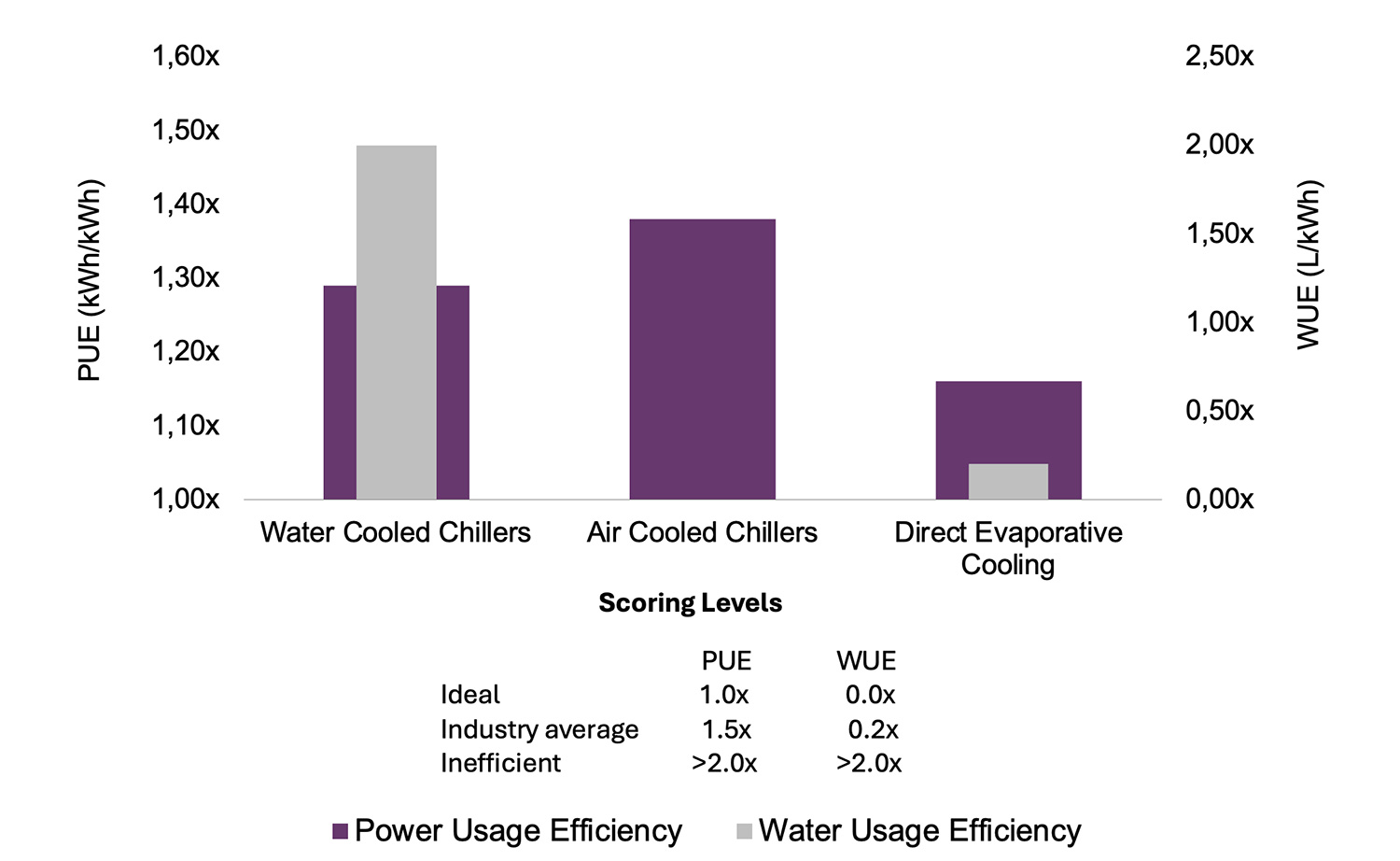
Source: IES, The Impact of Artificial Intelligence on Data Centre Cooling Requirements, January 2026
As such, Access’ most recent infrastructure direct co-investment is a highly energy-efficient underground data centre in Norway, built in an olivine mine and benefiting from fjord-water natural cooling.
Geographic selectivity is turning constraints into competitive advantage
Geographic selectivity is becoming a defining pillar of the data centre investment case in Europe. As AI-driven demand collides with the joint constraints of power and water, the attractiveness of the industry lies in data centres’ adaptability to local infrastructure and environment. Geography becomes a core determinant of asset quality, execution risk and long-term value creation. This requires disciplined assessment across four key local determinants:
1. Grid accessibility
As data centre power requirements increase, the ability to secure a timely, reliable and scalable grid connection can materially influence development timelines, capex planning and tenant delivery commitments. In locations where connection queues are long or grid reinforcement remains uncertain, projects may face delays, cost overruns or reduced expansion potential. For investors, grid accessibility should therefore be assessed in terms of current connection availability, but also in terms of future power scalability, visibility on grid upgrades and the reliability of local infrastructure planning. Assets located in areas with clearer grid capacity and stronger power supply visibility are likely to benefit from greater execution and more resilient long-term positioning.
2. Renewables alternatives capacity
Beyond grid access, the ability to secure credible low-carbon power is becoming an increasingly important differentiator. Hyperscaler tenants and large enterprise customers are placing greater emphasis on renewable energy procurement, while regulatory expectations around energy efficiency and decarbonisation continue to rise. The most resilient data centres will be those able to diversify their power sourcing strategy, through a combination of grid-based renewable supply, PPAs , on-site generation, storage solutions or other hybrid solutions. This flexibility matters because renewable availability can vary significantly by location, and because grid constraints may limit the ability to rely on a single sourcing channel. For investors, assessing a site’s capacity to adapt its power sourcing strategy over time is therefore central to underwriting tenant attractiveness, regulatory alignment and long-term competitiveness.
3. Electricity prices
Electricity prices are a fundamental driver of data centre economics, representing 40 to 60% of data centre operating costs. The investment focus is increasingly shifting from today’s electricity price to assess whether the asset can maintain a resilient and predictable energy cost base in a more volatile market. Locations exposed to volatile wholesale power markets, constrained grid capacity or energy security risks may face greater pressure on operating margins and tenant affordability. Conversely, sites with access to competitively priced, reliable and increasingly low-carbon electricity can offer stronger visibility on long-term operating performance. For investors, electricity cost resilience should be assessed with particular attention to the asset’s ability to secure long-term power arrangements and reduce exposure to future market volatility.
4. Water availability and cooling resilience
Water availability adds another layer of geographic selectivity, particularly as cooling needs rise with higher-density computing workloads. The relevance of water risk depends on local climate conditions, cooling technology, water source, municipal infrastructure and competition with other users such as households, agriculture or industry. In water-stressed areas, data centres may face greater permitting scrutiny, reputational pressure or future constraints on expansion. This makes it important to assess not only whether water is available today, but whether the asset’s cooling strategy remains sustainable under more constrained climate and regulatory conditions. For investors, water resilience should be analysed through a combination of basin-level water stress, cooling efficiency, reuse or recirculation potential, and dependency on freshwater resources.
In parallel, we integrate water exposure into our geographic ESG due diligence through basin-level water stress assessments, supply reliability and source. Beyond resource availability, we also review the sustainability of cooling processes, with a strong preference for solutions that limit freshwater dependency and support greater recirculation and reuse.
Access' diversified Data Centres portfolio across Europe
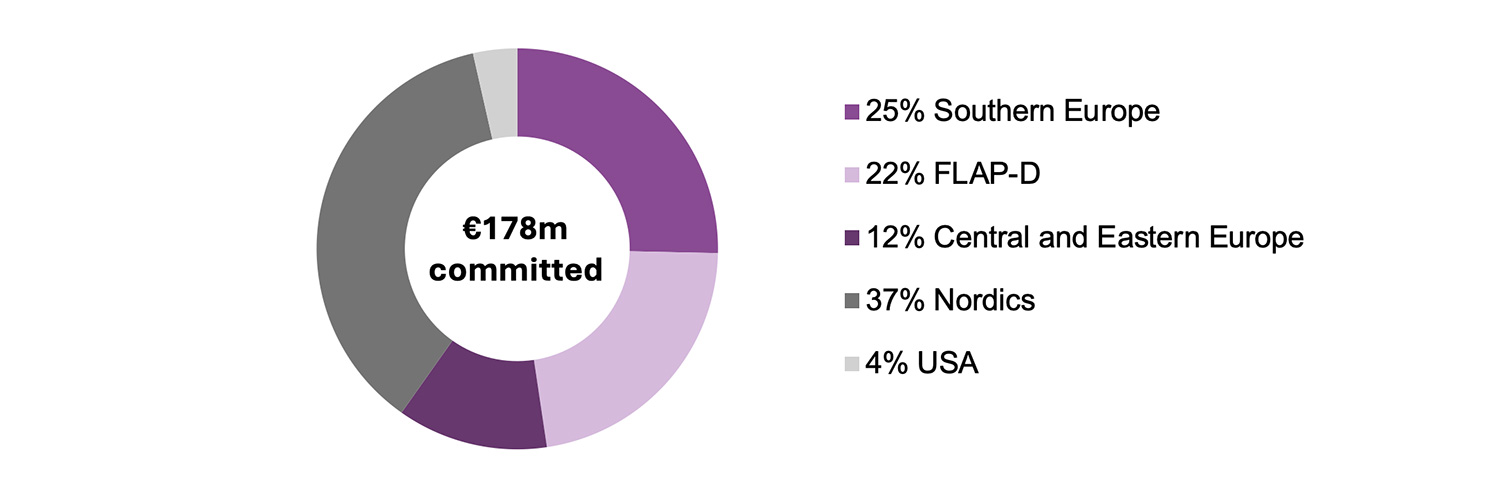
Source: Access Capital Partners internal data, includes advanced pipeline as of September 2026
Regulation risk
European sovereignty
The European Union is actively working towards a secure and independent digital future. Europe currently relies at over 80% on foreign entities , digital sovereignty is key to strengthening competitiveness, resilience, and strategic autonomy in a fast-changing digital world. The European Union announced committing over €100bn in digital infrastructure to address data centres concentration and AI data processing. Despite Europe’s wish for sovereignty, some local risks may arise, challenging data centres’ climate neutrality objective.
Local regulation risk assessment
The European regulatory framework and involvements translate into three identifiable investment risk channels, each intensifying as local regulators tightens data centres expansions and development:
- Permitting risk: Local authorities are becoming more sensitive to the cumulative effects of data-centre expansion on power systems and water resources. Regulators approvals are tightening, and in some cases politically contested, conditional to energy efficiency, renewable sourcing, and cooling performance standards. Authorities increasingly require monitoring, disclosure and water-efficiency planning for large users.
- Stranded asset and obsolescence risk: Legacy data centres in grid-constrained markets may require costly upgrades to meet stricter efficiency standards. While the shift to high-density AI computing accelerates obsolescence, as rack power needs are now far higher than for traditional workloads.
- Social license risk: Communities’ opposition to data centre development has grown, driven by scarcity of resources concerns for households, agriculture activity, and local industry. Data centres projects may encounter high scrutiny, longer timelines or reputational drag.
This translates into local permitting becoming driver of heightened financing risk and exit quality. Assets developed without properly assessing local conditions and resource constraints carry higher risk and may face refusal for expansion or further development.
Implications for infrastructure investors in Europe
European data centres are entering a more selective phase, where value creation will increasingly depend on the ability to identify assets positioned ahead of rising power and water constraints. While the sector remains structurally attractive, supported by cloud adoption, AI workloads and digital connectivity, broad exposure to market growth is no longer sufficient. Assets combining secure low-carbon power access, efficient cooling strategies, resilient locations and strong operational capabilities should be better positioned to capture durable valuation premiums, while reducing exposure to obsolescence, permitting pressure and oversupply risk.
Innovation and resource resilience
Innovation and resource resilience are becoming key indicators of asset quality. Next-generation cooling technologies, including liquid and immersion cooling, as well as locations with favourable resource profiles, can help mitigate the power-water trade-off and improve long-term cost competitiveness. For investors, these characteristics increasingly signal operator sophistication, regulatory alignment and the ability to scale sustainably.
Operational efficiency and execution
Operators able to secure long-term clean energy through PPAs benefit from structural advantages, including greater control over their energy cost base and enhanced credibility with hyperscaler tenants, who increasingly require robust clean energy sourcing from their colocation partners. Beyond energy procurement, leased capacity under long-term agreements ensure immediate cash flow generation and high forward revenue visibility. This contractual base significantly reduces lease-up risk and limits dependence on future demand assumptions, which is critical in a market characterised by both rapid growth and evolving technology requirements.
A broader ecosystem of adjacent infrastructure opportunities
The opportunity set also extends beyond data centres themselves. Resource constraints are creating demand for adjacent infrastructure, including renewable energy generation, grid connections, water treatment and recycling solutions, non-potable water sourcing and high-speed fibre networks. These assets benefit from the same structural digitalization tailwinds while offering distinct risk-return profiles aligned with infrastructure investment.
Access Capital Partners is well positioned to assess this broader opportunity set through its cross-sector infrastructure approach, with exposure across energy and renewables, digital infrastructure, transport and mobility, and environment and circularity. We evaluate data centre-related opportunities as part of a wider ecosystem shaped by digital demand, resource resilience, supply chain considerations, data sovereignty and cybersecurity requirements.